skip to main |
skip to sidebar

The Colosseum or Roman Coliseum, originally the Flavian Amphitheatre (Latin: Amphitheatrum Flavium, Italian Anfiteatro Flavio or Colosseo), is an elliptical amphitheatre in the center of the city of Rome, Italy, the largest ever built in the Roman Empire. It is one of the greatest works of Roman architecture and Roman engineering
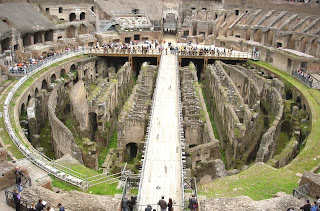
Occupying a site just east of the Roman Forum, its construction started between 70 and 72 AD under the emperor Vespasian and was completed in 80 AD under Titus, with further modifications being made during Domitian's reign (81–96). The name "Amphitheatrum Flavium" derives from both Vespasian's and Titus's family name

Capable of seating 50,000 spectators, the Colosseum was used for gladiatorial contests and public spectacles. As well as the gladiatorial games, other public spectacles were held there, such as mock sea battles, animal hunts, executions, re-enactments of famous battles, and dramas based on Classical mythology.
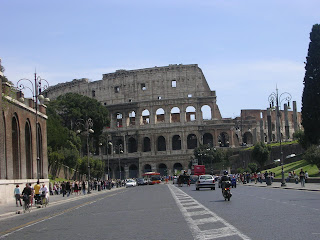
The colossem building ceased to be used for entertainment in the early medieval era. It was later reused for such purposes as housing, workshops, quarters for a religious order, a fortress, a quarry, and a Christian shrine.


Although in the 21st century it stays partially ruined due to damage caused by devastating earthquakes and stone-robbers, the Colosseum is an iconic symbol of Imperial Rome and its breakthrough achievements in earthquake engineering. It is one of Rome's most popular tourist attractions and still has close connections with the Roman Catholic Church, as each Good Friday the Pope leads a torchlit "Way of the Cross" procession around the various levels of the amphitheatre.

Petra is an archaeological site in Jordan, lying on the slope of Mount Hor in a basin among the mountains which form the eastern flank of Arabah (Wadi Araba), the large valley running from the Dead Sea to the Gulf of Aqaba.

It is renowned for its rock-cut architecture. Petra is also one of the new wonders of the world. The Nabateans constructed it as their capital city around 100 BC.

The site remained unknown to the Western world until 1812, when it was introduced to the West by Swiss explorer Johann Ludwig Burckhardt. It was famously described as "a rose-red city half as old as time" in a Newdigate prize-winning sonnet by John William Burgon. UNESCO has described it as "one of the most precious cultural properties of man's cultural heritage." In 1985, Petra was designated a World Heritage Site.

Pliny the Elder and other writers identify Petra as the capital of the Nabataeans, Aramaic-speaking Semites, and the centre of their caravan trade. Enclosed by towering rocks and watered by a perennial stream, Petra not only possessed the advantages of a fortress, but controlled the main commercial routes which passed through it to Gaza in the west, to Bosra and Damascus in the north, to Aqaba and Leuce Come on the Red Sea, and across the desert to the Persian Gulf.
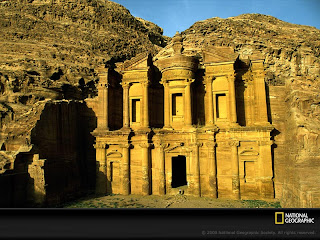
Excavations have demonstrated that it was the ability of the Nabataeans to control the water supply that led to the rise of the desert city, in effect creating an artificial oasis. The area is visited by flash floods and archaeological evidence demonstrates the Nabataeans controlled these floods by the use of dams, cisterns and water conduits. These innovations stored water for prolonged periods of drought, and enabled the petra city to prosper from its sale

Although in ancient times Petra might have been approached from the south via Saudi Arabia on a track leading around Jabal Haroun ("Aaron's Mountain"), across the plain of Petra, or possibly from the high plateau to the north, most modern visitors approach the ancient site from the east. The impressive eastern entrance leads steeply down through a dark, narrow gorge (in places only 3–4 metres wide) called the Siq ("the shaft"), a natural geological feature formed from a deep split in the sandstone rocks and serving as a waterway flowing into Wadi Musa.
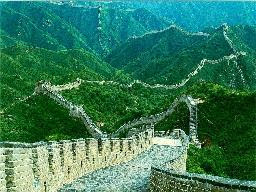
Landscape - Chinese Wall - one of the wonders of the world. The great wall of china, built to unite an empire, safeguard its people from invasions and the rein of its enemies from other parts of the world.

Images and desktop wallpapers of ancient houses built in to the mountains. They seem like the huge living things standing under the bright sun and staring to the sky. I often wonder how and things like these are possible.

Counted as one of the wonders of the world, Colosseum is the world renowned tourist attraction. It has a very scenic beauty and also have a bloody history.

The Taj Mahal is the symbol of love, the monument that was created in tribute to Mumtaz the loving wife of Mughal Ruler of India Shahjahan. It was built in 1631 Ad and is still standing majestically spreading its potion of love to the entire world. It is a world famous monument and every year tourists from all over the world visit Agra to capture the passionate beauty of the "symbol of love" The Taj Mahal.
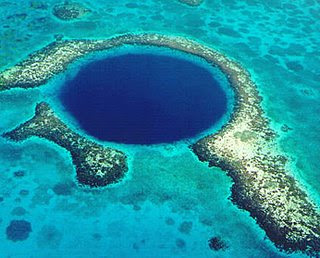
The Belize Barrier Reef is a series of coral reefs straddling the coast of Belize, roughly 300 meters offshore in the north and 40 kilometers in the south within the country limits. The Belize Barrier Reef is a 300 kilometers long section of the 900 kilometers long Mesoamerican Barrier Reef System, which is continuous from Cancun on the northeast tip of the Yucatán Peninsula through the Riviera Maya up to offshore Guatemala, making it the second largest coral reef system in the world after the Great Barrier Reef in Australia, popular for scuba diving and snorkeling. It is Belize's top tourist destination, attracting almost half of its 260,000 visitors, and vital to its fishing industry.
Charles Darwin described it as the most remarkable reef in the West Indies in 1842.

Machu Picchu is one of the most familiar symbols of the Inca Empire. It is also known as the "lost city". The Incas started building it around AD 1430 but was abandoned as an official site for the Inca rulers a hundred years later at the time of the Spanish conquest of the Inca Empire. Although known locally, it was largely unknown to the outside world before being brought to international attention in 1911 by Hiram Bingham, an American historian. Since then, Machu Picchu has become an important tourist attraction. Every year tourists come from around the world to visit this place and enjoy the nature of this beautiful landscape.

The Victoria Falls is located in southern Africa on the Zambezi River between the countries of Zambia and Zimbabwe. These falls are one of the largest waterfalls in the world.
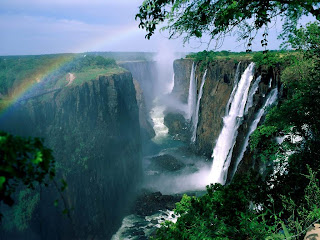
The mesmerizing view of the falls takes my breath away. It is a huge tourist attraction spot and one of the wonders of the world. Water to this falls flow all the way through the dense forest of South Africa.

Niagara Falls the beautiful and worlds most renowned waterfalls located in Canada. The picturesque view of the cascading water streaming down the mountains takes the breath away. Boating in those waters would be of great fun for every one who visit this place. It is one of the top most tourist attraction spot in all of Canada. In winters though this heaven of water gets covered with blocks of ice and snow, still it provides a pleasant view to the tourists.

The Hanging Gardens of Babylon, also known as the Hanging Gardens of Semiramis, near present-day Al Hillah, Babil in Iraq, is considered one of the original Seven Wonders of the World. They were built by the Chaldean king Nebuchadnezzar II around 600 BCE. He is reported to have constructed the gardens to please his sick wife, Amytis of Media, who longed for the trees and fragrant plants of her homeland Persia. The gardens were destroyed by several earthquakes after the 2nd century BCE.

The lush Hanging Gardens are extensively documented by Greek historians such as Strabo and Diodorus Siculus. Through the ages, the location may have been confused with gardens that existed at Nimrud, since tablets from there clearly show gardens. Writings on these tablets describe the possible use of something similar to an Archimedes screw as a process of raising the water to the required height. Nebuchadnezzar II also used massive slabs of stone, which was unheard of in Babylon, to prevent the water from eroding the ground.

The Niagara Falls are voluminous waterfalls on the Niagara River, straddling the international border between the Canadian province of Ontario and the U.S. state of New York. The falls are 17 miles (27 km) north-northwest of Buffalo, New York and 75 miles (120 km) south-southeast of Toronto, Ontario, between the twin cities of Niagara Falls, Ontario, and Niagara Falls, New York.

Download Beautiful and Natural Chichen Itza, Mexico desktop wallpapers, pictures, images and screen savers for free.

Chichen Itza (pronounced /tʃiːˈtʃɛn iːˈtsɑː/; from Yucatec Maya: Chi'ch'èen Ìitsha',"At the mouth of the well of the Itza") is a large pre-Columbian archaeological site built by the Maya civilization located in the northern center of the Yucatán Peninsula, in the Yucatán state, present-day Mexico.

Chichen Itza was a major regional focal point in the northern Maya lowlands from the Late Classic through the Terminal Classic and into the early portion of the Early Postclassic period.

The chichen itza site exhibits a multitude of architectural styles, from what is called “Mexicanized” and reminiscent of styles seen in central Mexico to the Puuc style found among the Puuc Maya of the northern lowlands.

Northern Yucatán is arid, and the interior has no above-ground rivers. There are two large, natural sink holes, called cenotes, that could have provided plentiful water year round at Chichen, making it attractive for settlement. Of the two cenotes, the "Cenote Sagrado" or Sacred Cenote (also variously known as the Sacred Well or Well of Sacrifice), is the more famous.

Ancient seven wonders of the world - Colossus of Rhodes desktop wallpapers, images, pictures and photos to download for free.

"The Colossus of Rhodes" redirects here. For the film by Sergio Leone, see I Colosso di Rodi.
This article is about the statue. For the children's novel by Caroline Lawrence, see The Colossus of Rhodes (novel).
This drawing of Colossus of Rhodes, which illustrated The Grolier Society's 1911 Book of Knowledge, is probably fanciful, as the statue likely did not stand astride the harbour mouth.
Colossus of Rhodes, imagined in a 16th-century engraving by Martin Heemskerck, part of his series of the Seven Wonders of the World.
The Colossus of Rhodes was a statue of the Greek god Helios, erected in the city of Rhodes on the Greek island of Rhodes by Chares of Lindos between 292 and 280 BC.

It is considered one of the Seven Wonders of the Ancient World. Before its destruction, the Colossus of Rhodes stood over 30 meters (107 ft) high, making it one of the tallest statues of the ancient world.

The statue stood for only 56 years until Rhodes was hit by an earthquake in 226 BC. The statue snapped at the knees and fell over on to the land. Ptolemy III offered to pay for the reconstruction of the statue, but the oracle of Delphi made the Rhodians afraid that they had offended Helios, and they declined to rebuild it. The remains lay on the ground as described by Strabo (xiv.2.5) for over 800 years, and even broken, they were so impressive that many traveled to see them.
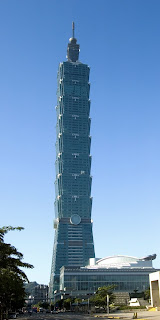
A multi-level shopping mall adjoining the Taipei tower houses hundreds of fashionable stores, restaurants and clubs.

Beautiful and Natural Taipei 101 desktop wallpapers, images, pictures and photos to download for free.

Taipei 101 is a landmark skyscraper located in Xinyi District, Taipei, Taiwan. The building, designed by C.Y. Lee & Partners and constructed primarily by KTRT Joint Venture, Samsung Engineering & Construction, is the world's tallest completed skyscraper according to the Council on Tall Buildings and Urban Habitat, the arbiter of tall building height.
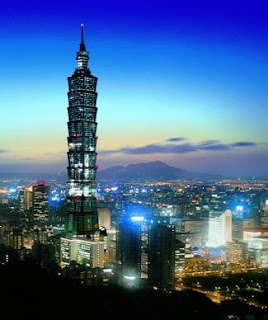
Taipei 101 received the Emporis Skyscraper Award in 2004. It has been hailed as one of the Seven New Wonders of the World (Newsweek magazine, 2006) and Seven Wonders of Engineering (Discovery Channel, 2005).

The taipei building contains 101 floors above ground and 5 floors underground. Its postmodern style combines Asian and international modern and traditional elements. It is designed to withstand typhoons and earthquakes.

Download free images, pictures, photos and desktop wallpapers of Burj Dubai

Burj Dubai ( "Dubai Tower"), a supertall skyscraper under construction in Dubai, United Arab Emirates, is the tallest man-made structure ever built. Construction began on 21 September 2004, and the tower is expected to be completed and ready for occupancy by late September 2009.

The total budget for the Burj Dubai project is about US$4.1 billion, and for the entire new "Downtown Dubai", US$20 billion.

Burj Dubai has been designed to be the centerpiece of a large-scale, mixed-use development that will include 30,000 homes, nine hotels such as the Burj Dubai Lake Hotel & Serviced Apartments, 3 hectares (7.4 acres) of parkland, at least 19 residential towers, the Dubai Mall, and the 12-hectare (30-acre) man-made Burj Dubai Lake.